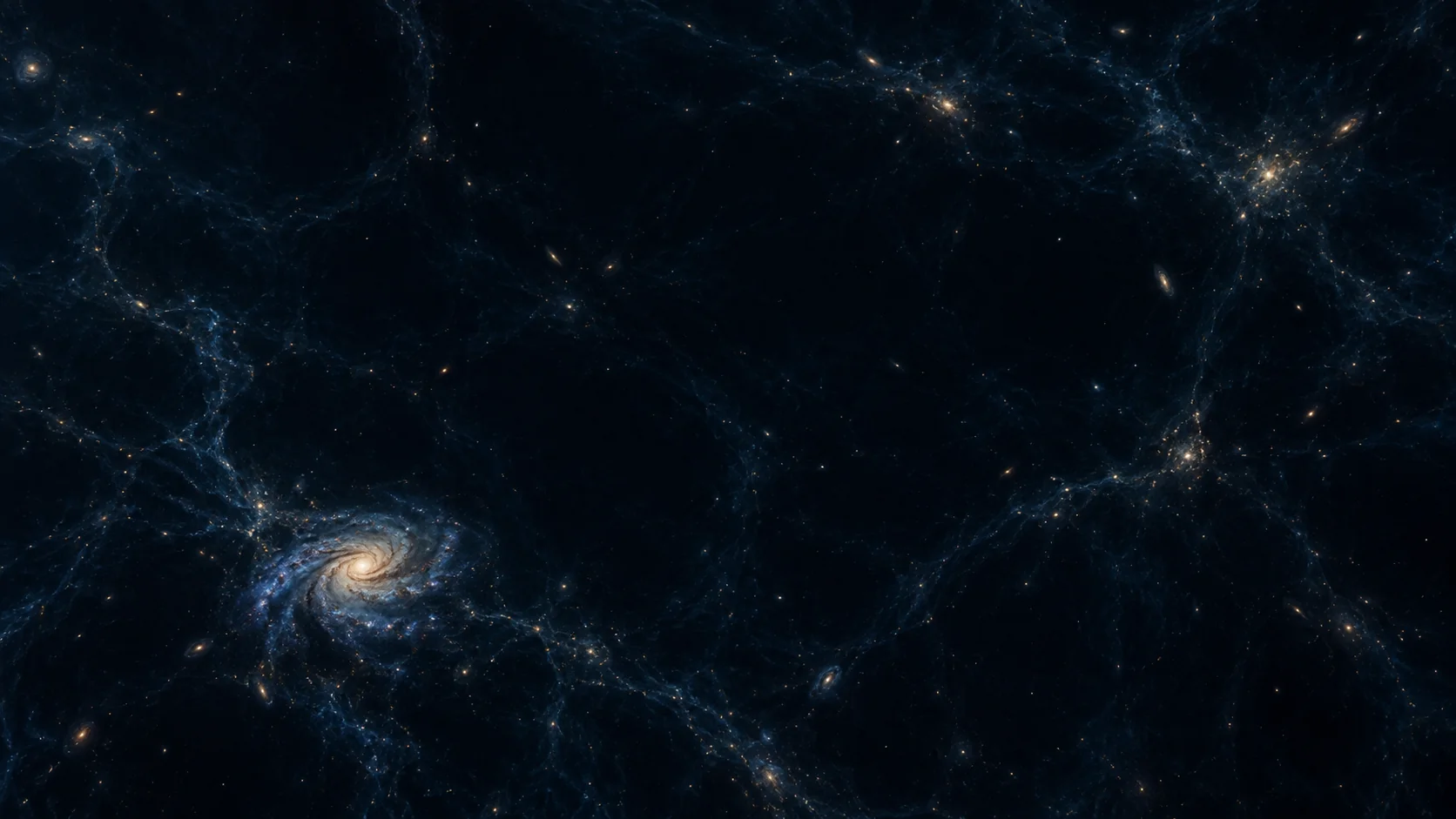
A galaxy seems enormous. A star fills our sky. A table feels perfectly solid. Yet at each of these scales, most of the space within the boundary we draw around an object is far from the compact pieces we picture as its contents. How empty is the universe, really?
That question drove my original essay. I began above our heads, with the Solar System and the Milky Way, then traveled inward through atoms, nuclei and protons. The exercise remains striking. Its numerical ratios are useful as a thought experiment, but a few claims about what lies between particles need a more careful reading today.
Between the Sun and Earth
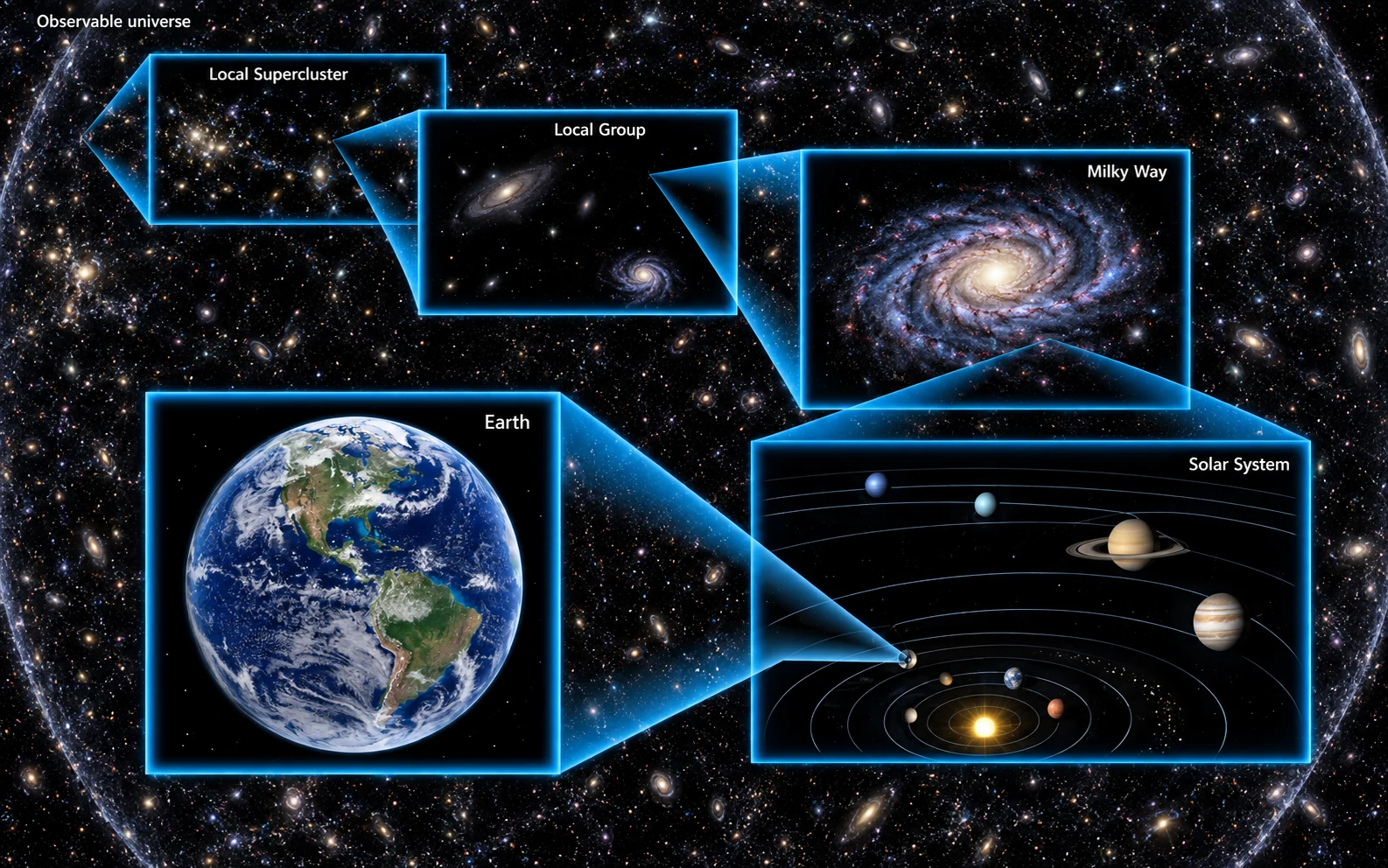
Imagine a sphere centered on the Sun, with Earth’s orbit at its surface. The Sun, Mercury, Venus, Earth and Moon occupy only a minute fraction of that imaginary sphere. Using their approximate physical volumes, the fraction is on the order of one part in ten million. Put another way, about 99.99999% of that geometrical volume lies outside those bodies.
This is a comparison of solid-body volumes, not a declaration that the intervening region contains literally nothing. Sunlight, the solar wind, dust, magnetic fields and other material pass through it. The point is the vast mismatch between the size of the bodies and the space they inhabit.
Extend the boundary to Neptune’s orbit and the proportion occupied by the Sun and planets becomes smaller still. The Sun dominates the total volume of the large bodies, while the diameter of its planetary system is thousands of times larger than the Sun itself. Beyond Neptune, scattered icy objects and the proposed Oort Cloud stretch the Solar System farther into the dark.
Between the stars and galaxies
Proxima Centauri, the closest star beyond the Sun, is roughly 4.25 light-years away. Even a star as large as the Sun is minuscule compared with such a separation. Spread hundreds of billions of stars across a galaxy tens of thousands of light-years wide, and the space actually inside their visible surfaces is a tiny fraction of the galactic volume.
My original calculation treated the Milky Way as a sphere and every star as a copy of the Sun. That produces a dramatic ratio, but the galaxy is a disk with a halo, stars have many sizes, and its space contains interstellar gas, dust, radiation and dark matter. It is fair to say that stars occupy very little of the galaxy’s geometric volume. It is not fair to infer that all the rest is a perfect vacuum.
The contrast widens when we think of the observable universe. Its present-day radius is about 46 billion light-years, even though the universe is about 13.8 billion years old: space expanded while the light traveled. The original essay used approximately 13 billion light-years as a radius and then multiplied guessed numbers of stars and galaxies into a long string of nines. The intuition about sparse, compact luminous bodies remains useful; the exact percentage depends on arbitrary boundaries and omits diffuse matter and fields.
Inside what feels solid
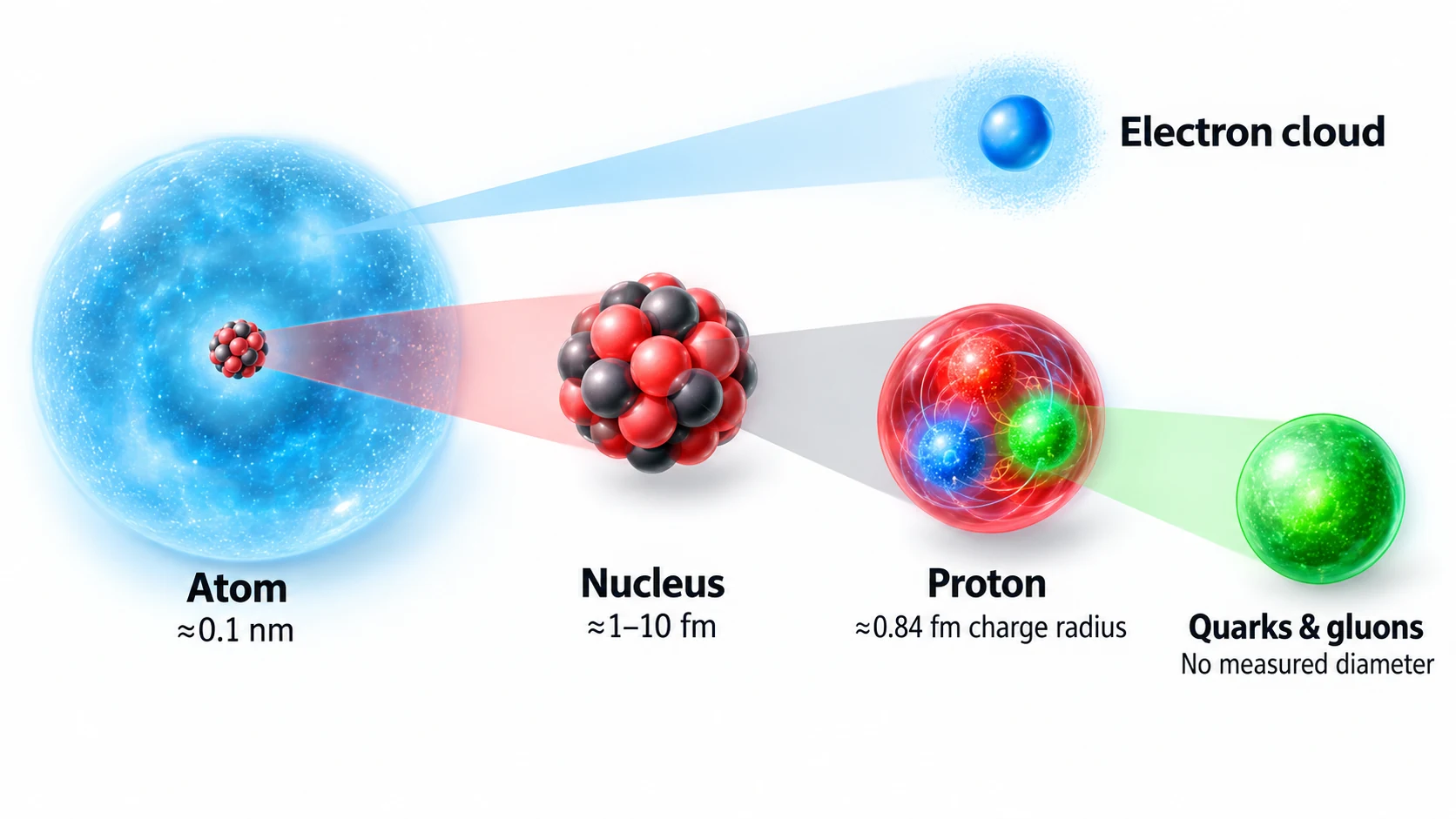
Now turn from the night sky to the table beneath your hand. Matter is built from atoms. An atom’s nucleus is roughly tens of thousands of times smaller in diameter than the full atom, depending on which atom and which definition of size we use. If we represent both as simple spheres, the nucleus occupies a vanishingly small fraction of the atom’s geometric volume, roughly a trillionth or less in a representative example.
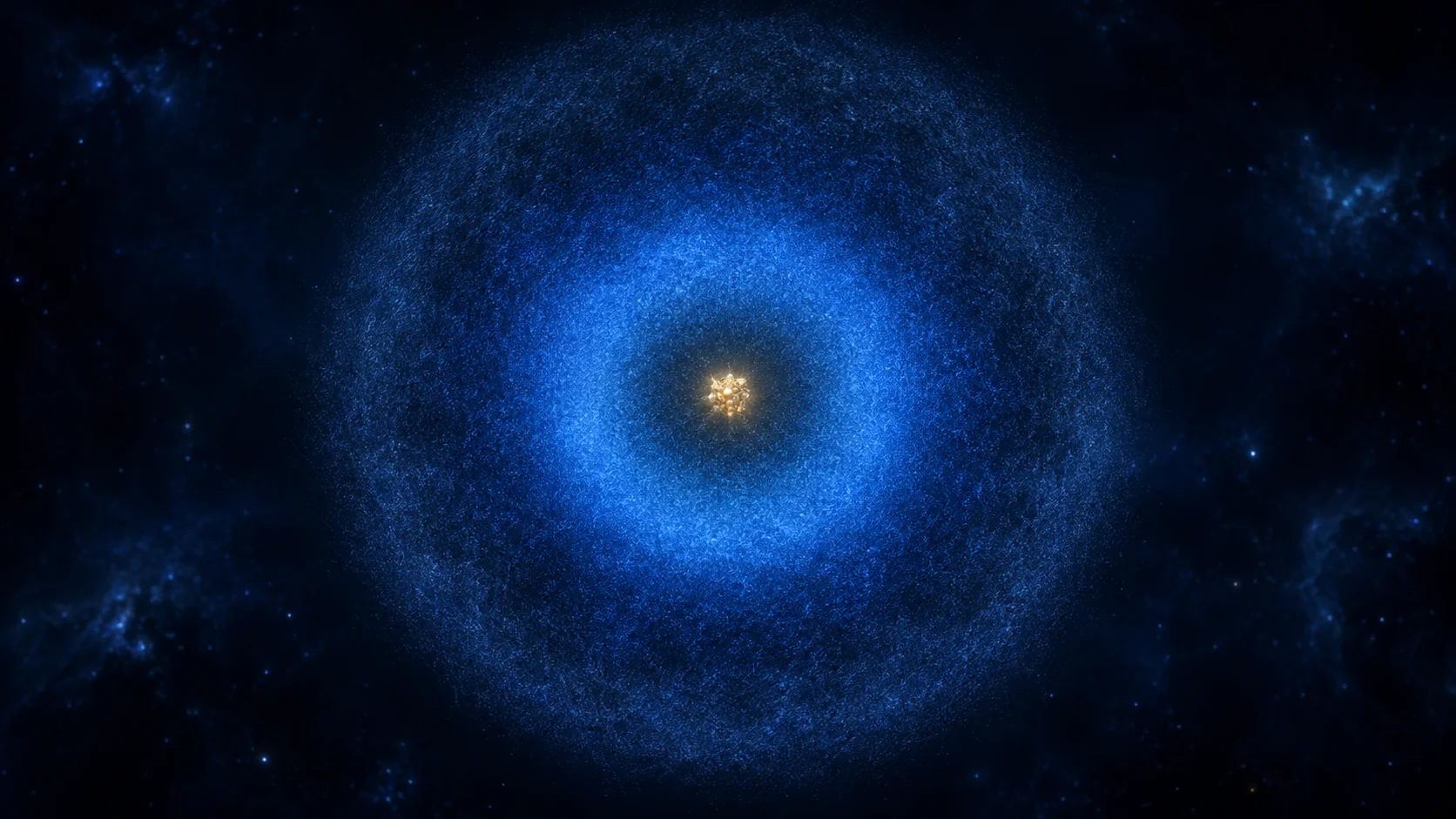
It is tempting to call the rest “empty.” But electrons do not orbit like little planets around a Sun. Quantum mechanics describes where an electron can be found through a spread-out probability distribution. Electric fields and quantum rules govern how atoms bind and resist being pressed into one another. That is why the table feels solid despite the tiny nucleus. “Not filled by a nucleus” is much more precise than “physically nothing is there.”
Inside the nucleus and proton
Atomic nuclei contain protons and neutrons. A nucleus is not a bag of tiny, rigid spheres separated by ordinary empty gaps; it is a bound quantum system. Protons and neutrons themselves are made of quarks interacting through gluons. The original essay imagined three quarks with measurable tiny diameters inside a proton, multiplied their imagined volumes, and concluded that almost all of the proton is empty too.
That last multiplication does not work. Quarks are not known to have a measurable ball-like radius that can be inserted into a packing calculation. A proton contains three valence quarks, but also a changing sea of quark–antiquark pairs and gluon fields. Much of its mass arises from the energy of those interactions, not from adding up the masses or volumes of three little beads.
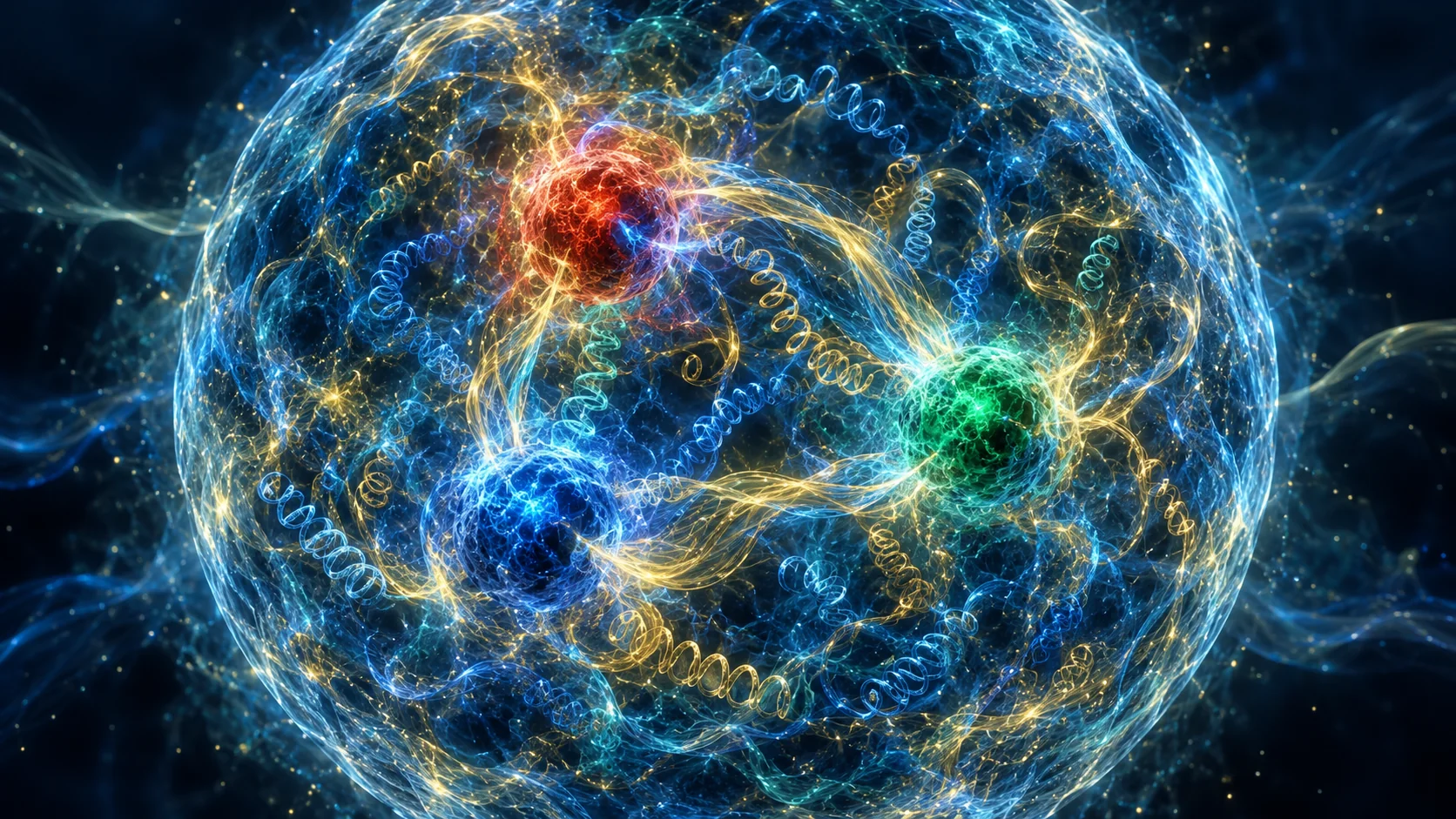
There is no evidence that every particle can be broken indefinitely into smaller solid pieces. Our current experiments treat electrons and quarks as elementary to the scales we can probe. That may change with future discoveries; the possibility is an open question, not an established infinite sequence.
What does “empty” mean?
The journey from galaxy to atom does reveal a remarkable pattern: compact objects often occupy a tiny fraction of the larger region we assign to them. But each step uses a different definition of size. A sphere out to Neptune is a geometrical choice. A galaxy has a diffuse boundary. An atom has an electron distribution rather than a crisp surface. A proton is a dynamical quantum system. Multiplying all their apparent “empty fractions” into one precise percentage would give a number without a clear physical meaning.
My original conclusion was philosophical: perhaps matter is an effect rather than a collection of perfectly solid, indivisible blocks. In a useful sense, that insight survives. What feels solid emerges from fields, interactions and quantum behavior; the proton’s mass is largely energy in a bound system. But this does not make matter unreal, nor does it prove that the universe is literally nothing. Its measurable structure is real even when our childhood picture of tiny hard balls fails.
The universe can be sparse without being vacant, and matter can be real without being made of miniature solid marbles.
The more we zoom out or in, the more our simple notion of “filled” gives way to relationships, forces and patterns. That is the enduring wonder behind the original question: if the world’s solidity is an effect of how its parts interact, perhaps understanding those interactions tells us more about matter than counting the volume of its smallest pieces ever could.
Revisited from my 2021 Facebook article. The scale journey and philosophical question are retained; the observable-universe radius and subatomic claims have been updated. Background: NASA/JPL on cosmic scale, NASA on galaxies, DOE on electrons, and CERN on proton mass.