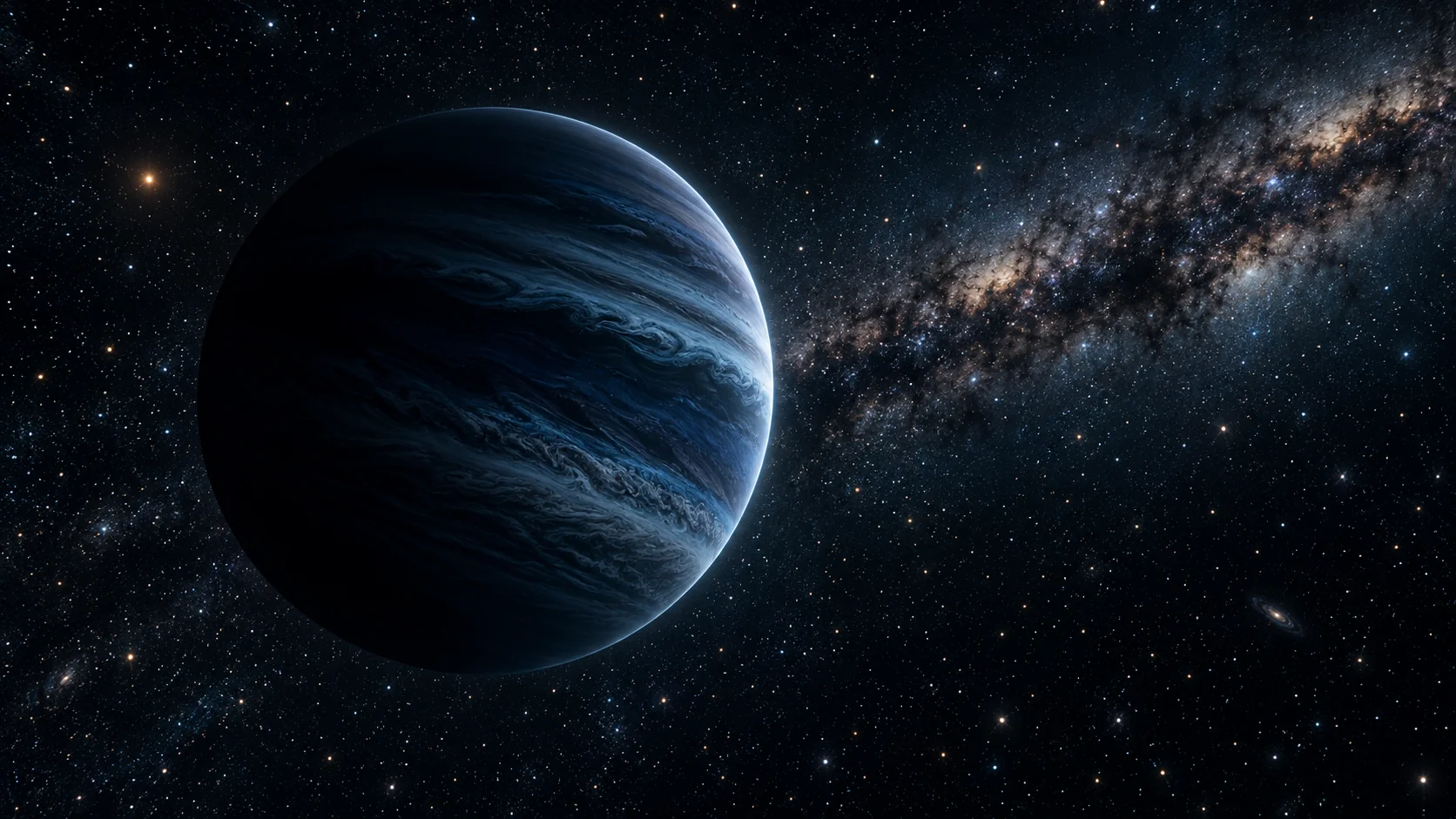
We know the planets, moons, comets and asteroids orbiting the Sun. Then we hear that the next star is more than four light-years away, and the interval seems like a great empty gulf. But what if some of the most interesting things in that gulf are simply too cold and faint to notice?
That was the question I asked in the original version of this essay. It led from unseen planets to stellar remnants and, finally, to the possibility of a black hole moving silently through the dark. The thought is still compelling. Today we can separate what observations support from what remains an imaginative possibility.
We usually find planets by watching their stars
Many exoplanets announce themselves indirectly. A planet may pass in front of its star, briefly reducing the starlight we receive. Its gravity may make the star wobble, shifting its spectrum. These methods work best for particular sizes, orbits and viewing angles. Direct images of planets do exist, but they remain far harder to obtain than detections through a host star.
Now remove the star. A planet drifting freely through interstellar space has no bright host to dim and no stellar wobble to measure. It can still emit faint heat, reflect distant light or briefly magnify a background star through gravitational microlensing. The absence of a parent star makes it more elusive; it does not make it fundamentally invisible.
A giant planet one light-year away
Imagine a Jupiter-sized body roughly one light-year from us. It would be vastly farther away than Jupiter is when we see it in our own Solar System. Its angular diameter would shrink with distance. If it had no nearby star, reflected light would be especially weak; any remaining infrared glow would depend on its temperature and age. A simple brightness comparison with Jupiter is therefore only a thought experiment, not a proof that such an object could never be found.
Nor should we confuse “not yet seen” with “unconstrained.” Infrared surveys have searched the sky for cold nearby bodies. NASA’s WISE survey found no Saturn-sized or larger object within 10,000 astronomical units of the Sun and no Jupiter-sized or larger object within 26,000 astronomical units. One light-year is farther still, but the result rules out some of the more dramatic nearby-giant scenarios imagined in earlier decades.
For smaller or more distant objects, the map remains incomplete. Astronomers use infrared observations, stellar motions, occultations and microlensing to keep extending it. A solitary planet may pass across a distant line of sight and reveal itself only through a temporary brightening of a background star.
How does a planet become a wanderer?
The heavy elements in rocky worlds were forged by earlier generations of stars. That part of the original reasoning was right: the material of planets has a history older than the Sun. But our planets were not simply assembled from random dead-star debris that the finished Sun happened to capture. The Sun and its planets formed together from a collapsing cloud of gas and dust. Material in the resulting disk built the planets, asteroids and comets.
Young planetary systems are dynamic. Close encounters and gravitational interactions can scatter objects outward. Some remain bound to a star on vast, slow orbits; some can be ejected into interstellar space. The proposed Oort Cloud is a reservoir of icy bodies still gravitationally bound to the Sun. A genuinely free-floating planet has left a star’s system altogether. Both can be difficult to find, but they are different populations.
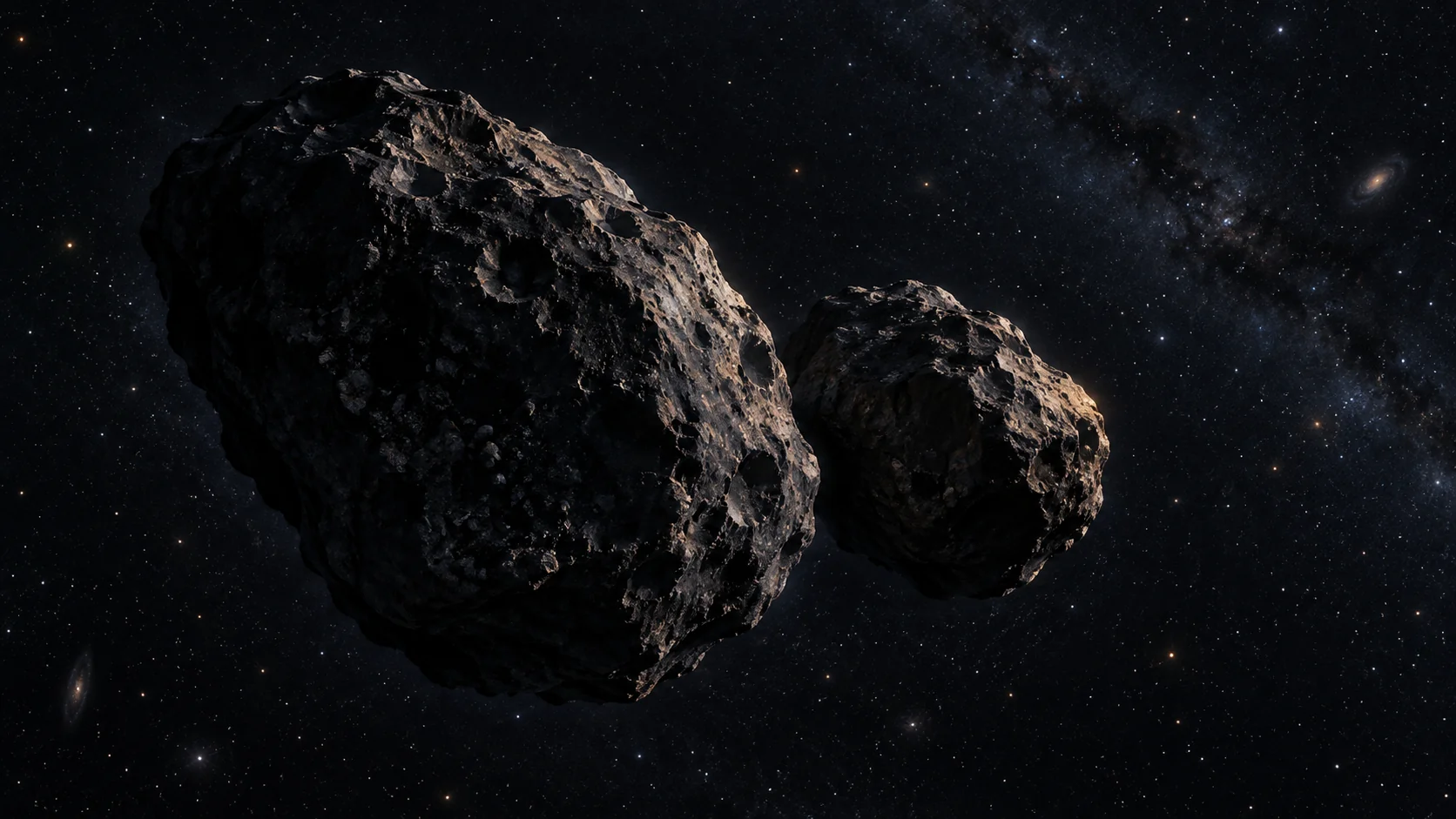
Could two small bodies remain bound to each other while the pair wanders? In principle, yes, if their mutual orbit survives whatever interaction released them. The image above is a possibility to contemplate, not a claim that this particular pair has been discovered between stars.
Dead stars and their surviving companions
Stars end in different ways. A Sun-like star leaves a white dwarf that slowly cools. More massive stars can leave neutron stars or black holes. Some planetary material may survive a star’s transformation, move to new orbits or form anew from leftover debris. “Dead stellar system” is a useful image, although a white dwarf is still observable and a remnant’s surroundings can sometimes betray it.
The more unsettling case is an isolated black hole. If it is not feeding on nearby gas, it may emit almost no light of its own. Yet its gravity does not disappear. Far from any roughly spherical body, the gravitational pull depends on its mass and distance: an object of the same mass produces essentially the same distant gravitational field whether it is a diffuse star or a compact black hole. Close to the black hole, of course, the physics changes drastically.
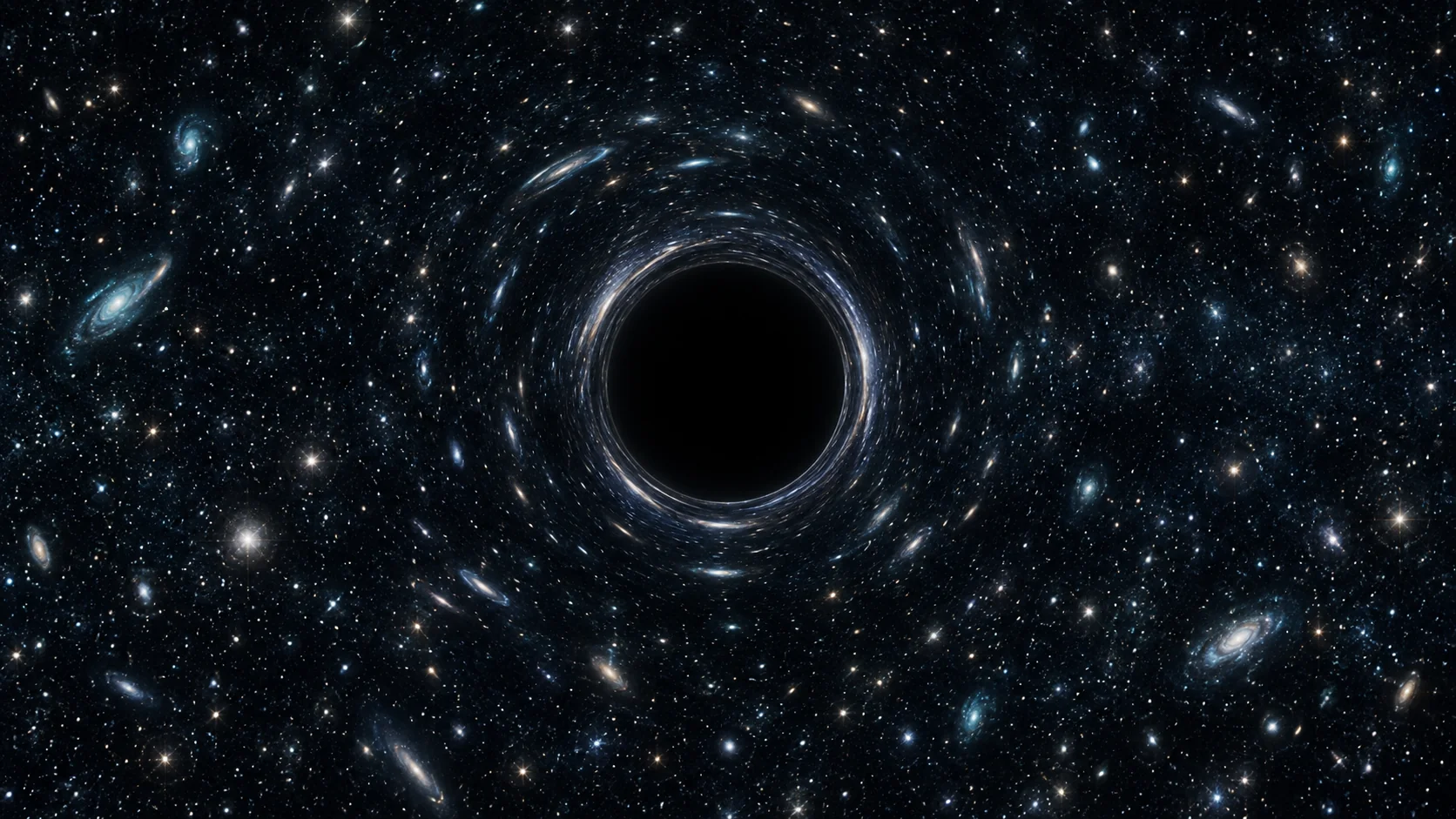
Such an object could be found through a star’s apparent motion, a microlensing event or the effect of a close passage on other bodies. Astronomers have detected the gravitational signature of isolated black-hole candidates through microlensing. This is why “dark” never means wholly beyond investigation.
What could be nearby?
My original closing question imagined a cold black hole wandering toward the Solar System: would we notice it in time? It remains a striking way to think about the limits of observation, but it should not be read as evidence that one is approaching us. A nearby massive object would increasingly disturb known orbits and background light, and surveys constrain many possible hidden neighbors. There is no established evidence for an unseen black hole threatening the Solar System.
Space is not empty merely because its quietest travelers have yet to announce themselves.
The more fruitful thought is not impending catastrophe. It is that every method of seeing has a selection bias. Stars make their planets easier to find; an isolated world asks us to look for heat, gravity or a fleeting alignment. The silent wanderers may be planets, small bodies or stellar remnants. Each new way of observing makes the dark between stars a little less empty.
Revisited from my 2021 Facebook article. The original thought experiment and concluding question are retained, with updated explanations of planet formation, detection and nearby-object constraints. Further reading: NASA on rogue planets, NASA on the Oort Cloud, JPL on WISE’s nearby-object search, and NASA on black-hole microlensing.