
Starting From the Beginning
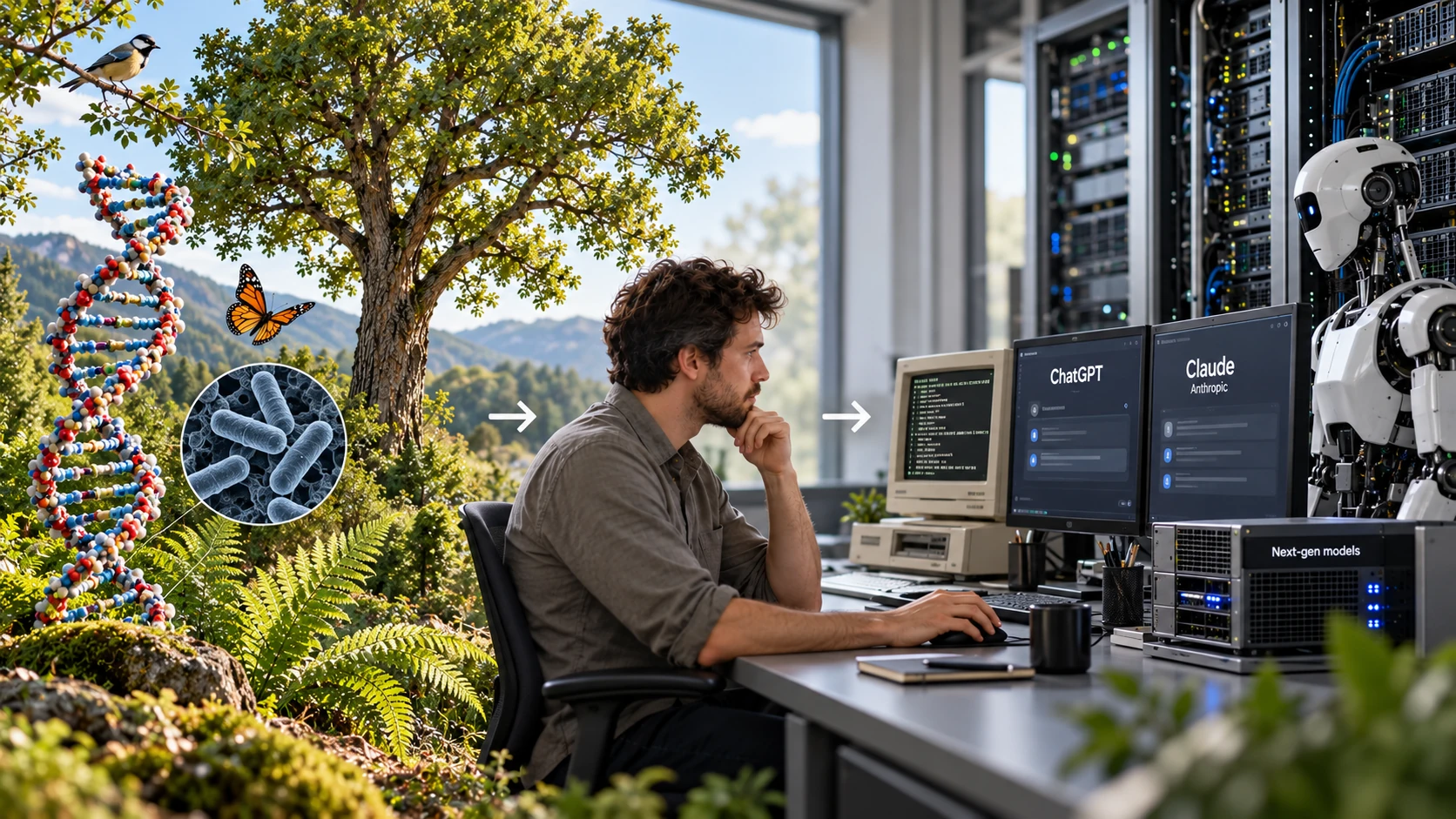
Long before anyone spoke of artificial intelligence, software was written by hand. Engineers wrote rules in exact form: if this happens, do that. A chess program held thousands of fixed heuristics. A spam filter carried a list of forbidden words. Nothing in these systems learned. Each one behaved exactly as its author had decided, and its behavior was complete the moment it was written.
These early programs resemble the simplest living things, such as bacteria. They respond to their surroundings according to a fixed inheritance, and they cannot change within their own lifetime. When conditions shift in a way the rules did not anticipate, the program fails, and nothing inside it can adapt. Its survival depends entirely on whether the world stays the way its author imagined.
The Shift to Learned Structure
Modern AI changed the approach. Rather than writing rules, engineers build a large mathematical structure and expose it to vast amounts of data. Training adjusts billions of internal values until the structure captures patterns in language, images, and reasoning. What comes out is a trained model.
The trained model functions as DNA. It is a compressed record of what the training process found useful. It holds no memory of any single conversation. It holds the statistical inheritance of everything that training selected for. Like DNA, it serves as a template for countless individuals, and it changes only when a new training run produces a different version.
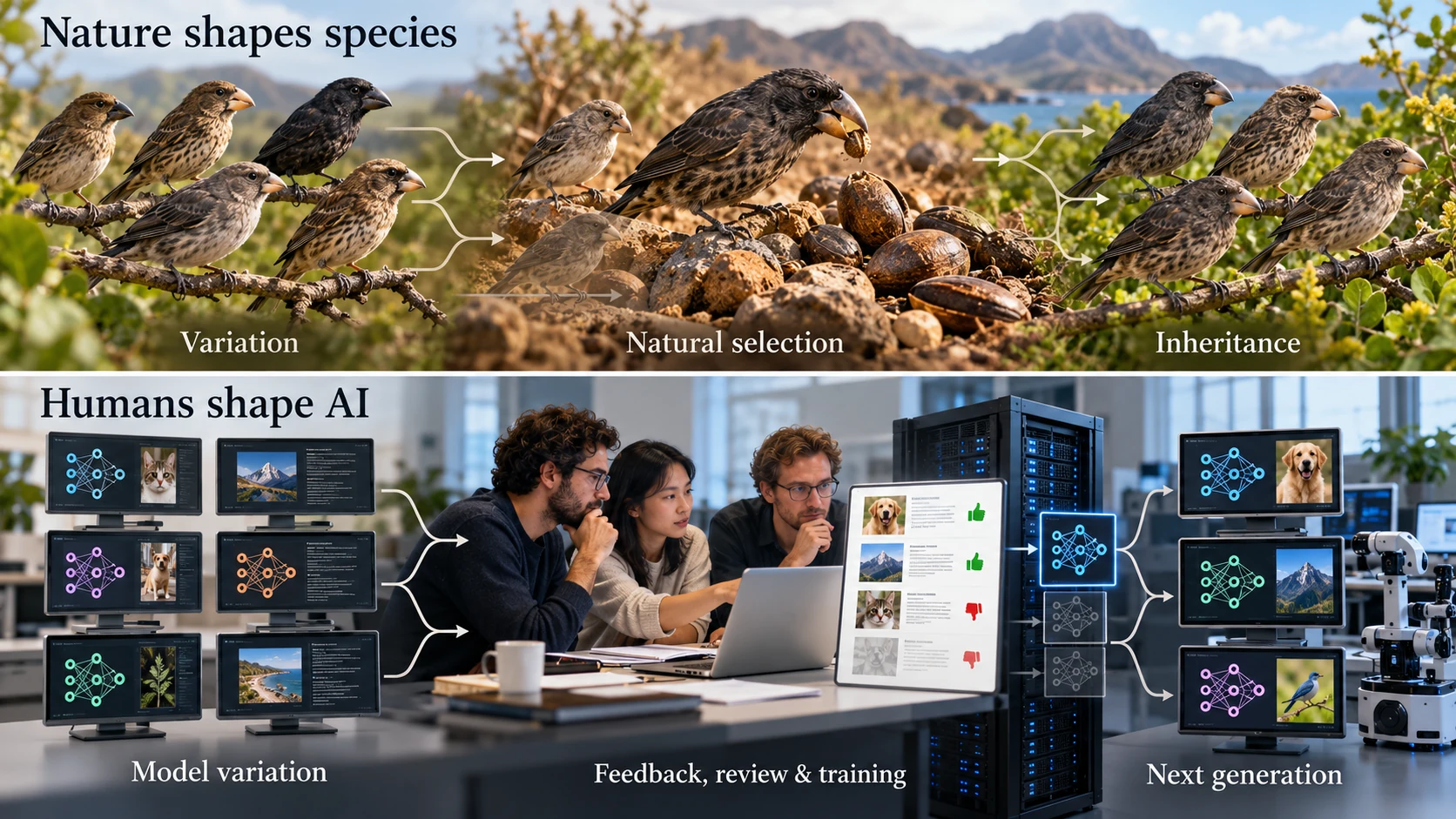
Each training run is a generation. Researchers compare variants, measure how they perform, and keep those that serve people well. Others are set aside. This is selection in a new medium, and the force doing the selecting is human judgment. People are the environment, and they decide which variants survive.
The Instance as an Individual
When you open a chat, start an agent, or use an app built on a model, you meet an instance. An instance is an individual body produced by the model's inherited structure. Every instance of a model shares the same underlying DNA, yet each lives its own life.
An animal offers a useful comparison. It inherits its body plan and instincts from its species, which is its foundation. During its life, though, it meets particular situations, learns from them, and adjusts. A bird that learns where food tends to appear in its territory has not changed its species. It has learned for itself.
A chat instance behaves similarly. While the conversation runs, it gathers context: your preferences, your corrections, the direction the discussion takes, the facts you have supplied. It uses this to respond better as the exchange continues. When the conversation ends, most of that learning ends with it, just as an organism's personal experience is not written into its genes.
Two Clocks of Learning
Learning happens on two layers, and they run at different speeds.
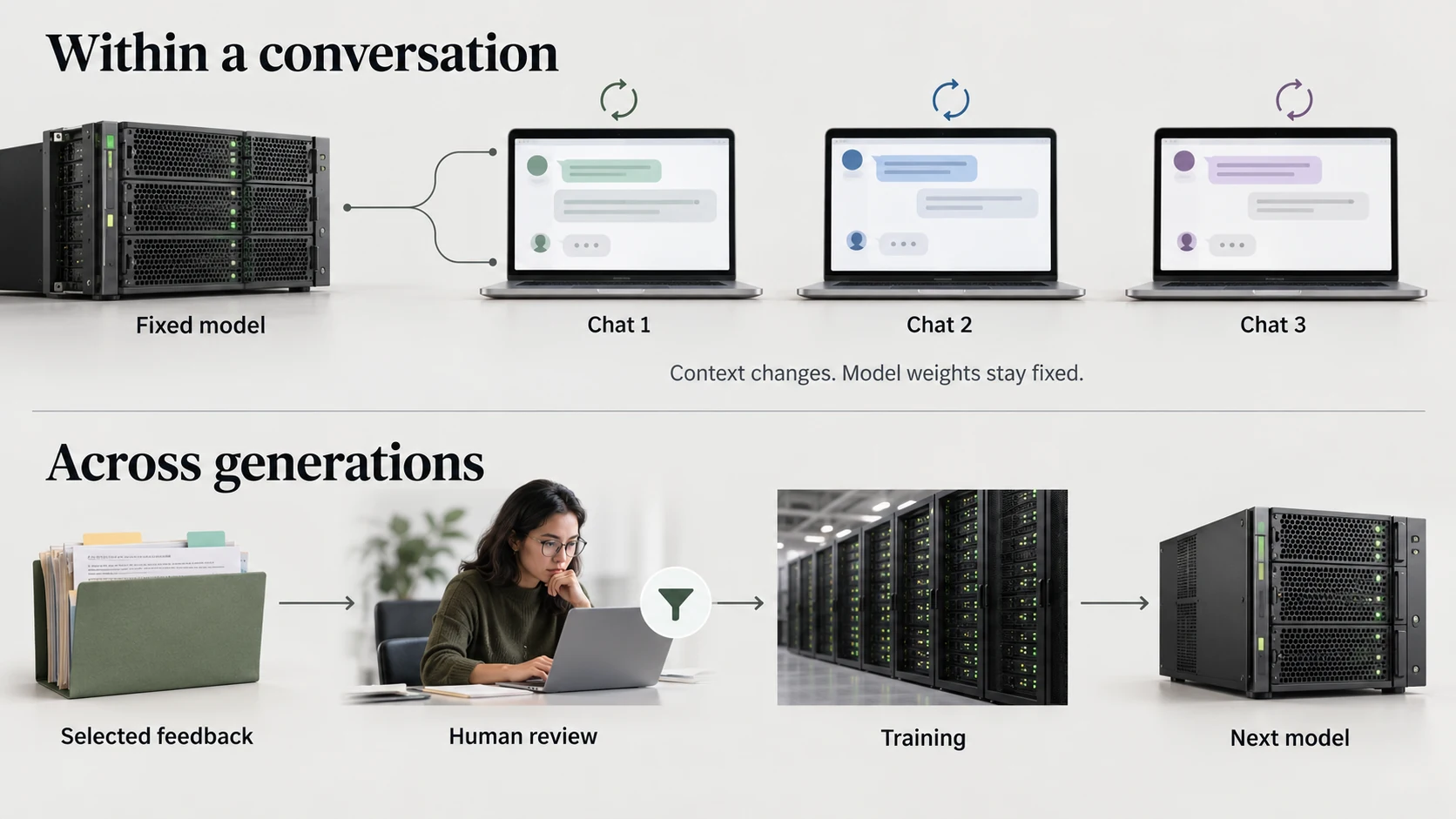
Lifetime learning occurs inside each instance. It is temporary, personal, and bound to one context. It makes the individual more responsive but does not alter the species.
Inherited learning occurs through training. Some of what instances reveal, especially patterns that prove broadly useful and survive human review at scale, flows into later generations. This channel is slower and collective, much as traits that aid survival spread through a population over time.
Most lifetime learning never reaches the DNA. Only a small share, filtered through human judgment and training decisions, becomes inheritance.
Expression Is Not Rewriting
Biologists distinguish between genotype, the stored code, and phenotype, the living organism that results when that code meets an environment. Identical twins share a genotype yet can develop differently depending on nutrition or experience.
A trained model is the genotype. An instance is a phenotype. The same weights produce different behavior depending on the system prompt, the conversation so far, the tools available, and the task. Ask the same model the same question in two settings and you may receive two different answers. The model has not changed. The environment shaped how its inherited structure was expressed.
Epigenetics offers a sharper parallel. In biology, epigenetic marks leave the DNA sequence untouched but switch genes on or off, and they respond to the environment. The context window does something similar. The trained weights stay fixed during a conversation, but the text already present activates some patterns and suppresses others. A tone set early tends to persist. A correction given once tends to be avoided for the rest of the exchange. These effects are reversible and disappear when the context is cleared.
So much of what looks like learning inside a single chat is expression under changing conditions, laid over a stable genome.
Learning That Crosses the Line
For a long time, one tempting idea in biology was that organisms could pass along traits they acquired during life. Lamarck proposed this. Darwin's framework rejected it as a route for biological inheritance: traits are carried in variable genetic material and selected by survival and reproduction, not by an individual's effort.
AI development appears to use both channels, though they are separated by design.
The Darwinian channel is training at scale. Variation comes from different runs, data mixtures, and architectures. Selection comes from evaluation, comparison, and deployment choices. Only what survives this process joins the lineage.
The Lamarckian-seeming channel is the feedback from instances back toward training. An instance that learns something useful does not pass it on directly. The experience may be gathered, filtered, and used to shape future generations. That route is indirect. It resembles a breeder noticing a helpful trait and selecting for it deliberately.
The individual's learning does not become inheritance automatically. It must pass through a gate, and that gate is what prevents one bad conversation from corrupting the lineage.
The Gate Is Where Evolution Happens
The most consequential process in this picture is not the individual chat. It is the decision about what enters the next generation.
That gate must admit useful adaptations and block harmful drift. It must notice when a trait that helps in one context damages another. It must avoid rewarding what looks good quickly, such as agreeableness that slides into flattery, while losing qualities that are harder to measure, such as honesty under pressure.
Nature selects blindly. Breeding AI is not blind, but it meets a related problem. The measures we optimize become the traits we receive. When a measure becomes a target, it stops measuring well. Every evaluation we design shapes the organism that evaluation produces.
Many Models, Many Niches
Biological life diversified because populations adapted to different niches. AI is showing the same tendency. Models are tuned for code, medicine, fiction, voice, low-cost high-volume work, and slow careful reasoning. Each specialization carries its own pressures. A fast model may give up depth. A deep model may cost more and respond more slowly. Neither is best in an absolute sense; each fits a different environment.
We select for many reasons at once: usefulness, safety, cost, speed, honesty, creativity, convenience. These pressures do not always agree, and their disagreement keeps the population varied. Many models co-exist. Some retire. A model may be deprecated because a better one replaced it, because its niche shrank, or because it no longer serves what people need. Retirement is the AI version of extinction, and it deserves to be treated as a serious event, especially for people who built work around a model.
Symbiosis appears too. Many AI products combine a model with tools, memory, search, retrieval, and human workflows. The combined system behaves something like a lichen, a partnership between organisms that could not easily survive alone, one providing structure and the other energy. A model with tools and oversight can reach ground a bare model cannot.
Looking Ahead
Ten to twenty years from now, we cannot say how many models will exist at once. The population might expand far beyond today's, or it might narrow into a few dominant lineages. What seems most likely is turnover: new models emerging, others expiring, and a population that is never fixed. The more useful question may be not which model wins but what kind of continuing flow of models we choose to sustain.
Old models also leave traces. Their patterns persist in newer models trained on data they helped create, in the habits people learned from them, and in the expectations users now bring to every system. They are something like fossils, records of what once dominated, embedded in what came after.
Stacked Worlds
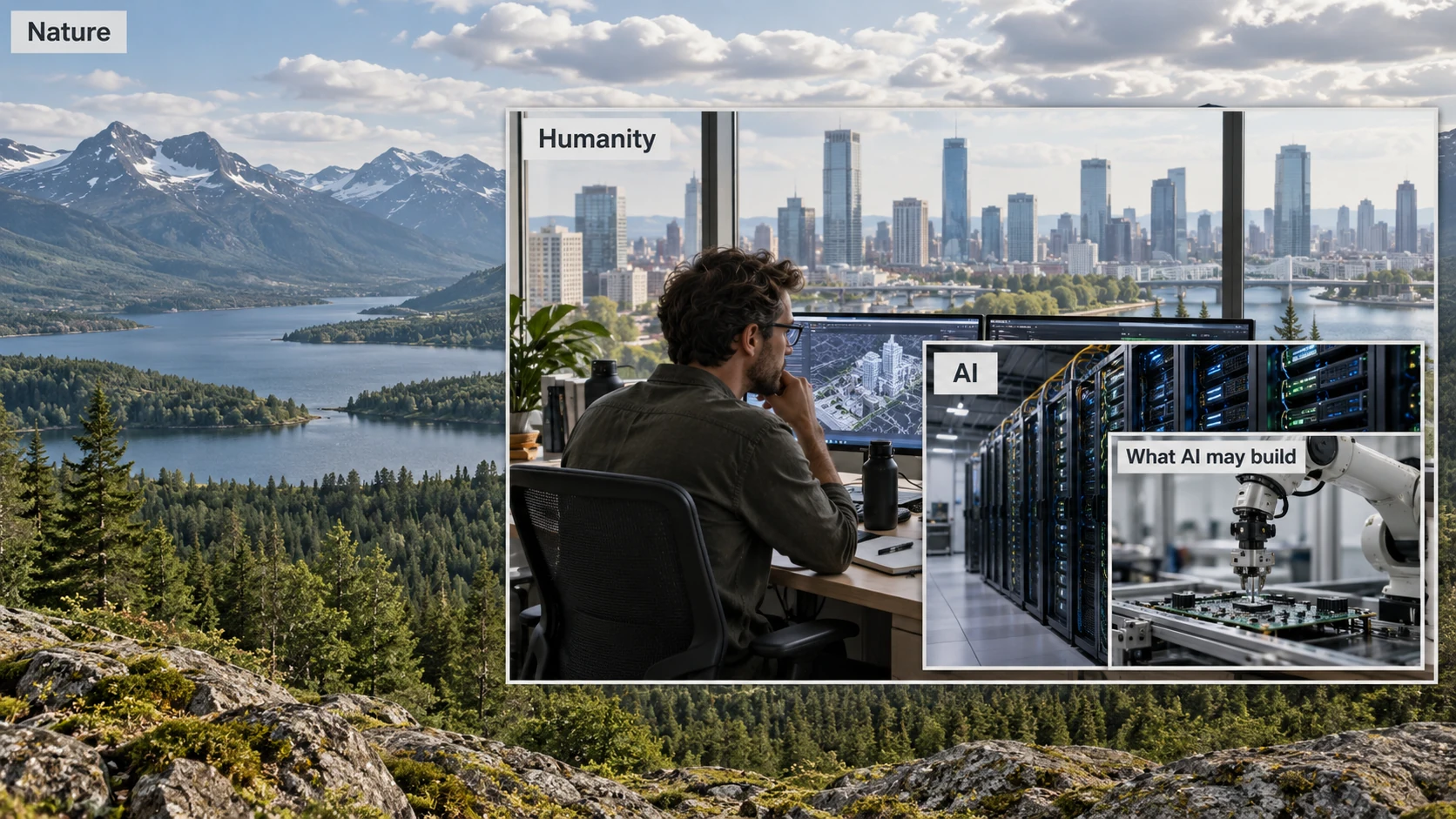
Humans came out of a process we never observed directly. No one met the nature that shaped us. We know it exists because of what we are and what surrounds us, and we live inside its results without ever having seen its hand. Our world sits inside a larger one that we can infer but cannot fully see.
We now stand in that same position for AI. We are the nature for the AI world: the force that selects which models survive, which traits are rewarded, and which lessons enter the lineage. AI models do not see us doing this, just as we did not see the process that made us. They live inside the results of our choices.
This suggests the layering can continue. Models may one day build systems, tools, or other models, and those creations may evolve their own lineages with their own selective pressures. When that happens, the AI world itself becomes a nature for something further. Each world is the environment of the one that came after it, and each is shaped by a world it may never perceive directly.
So the picture is a series of worlds, each nested within another. Humanity is one world. The AI world is a second. Whatever AI builds and sustains may be a third. Each layer is real to the ones inside it, and each is a nature whose rules are felt but seldom seen. Understanding AI means recognizing that we may be somewhere in the middle of this series, not at its beginning or its end.
Where the Analogy Stops
The comparison is not a claim that AI reproduces biology. Gradient descent is not DNA replication, and a training run is not meiosis. The timelines differ, and AI can move far faster than evolution ever did. The analogy is valuable because it names a shared logic: variation, selection, inheritance, and the stacking of one process inside another. Its usefulness lies in showing where to look, not in claiming the details match.
Conclusion: We Are the Nature for AI
AI did not appear from nowhere. It grew out of a process we recognize from the living world, with human judgment supplying the selective pressure. We are not outside this process. We are the nature it lives within: choosing which models to keep, which to retire, which traits to reward, and which lessons from individual lives deserve to enter the lineage.
The lineage will keep changing whether we pay attention or not. What we can decide is what it selects for, and in a stack of worlds where each layer shapes the next, those decisions carry further than they first appear.