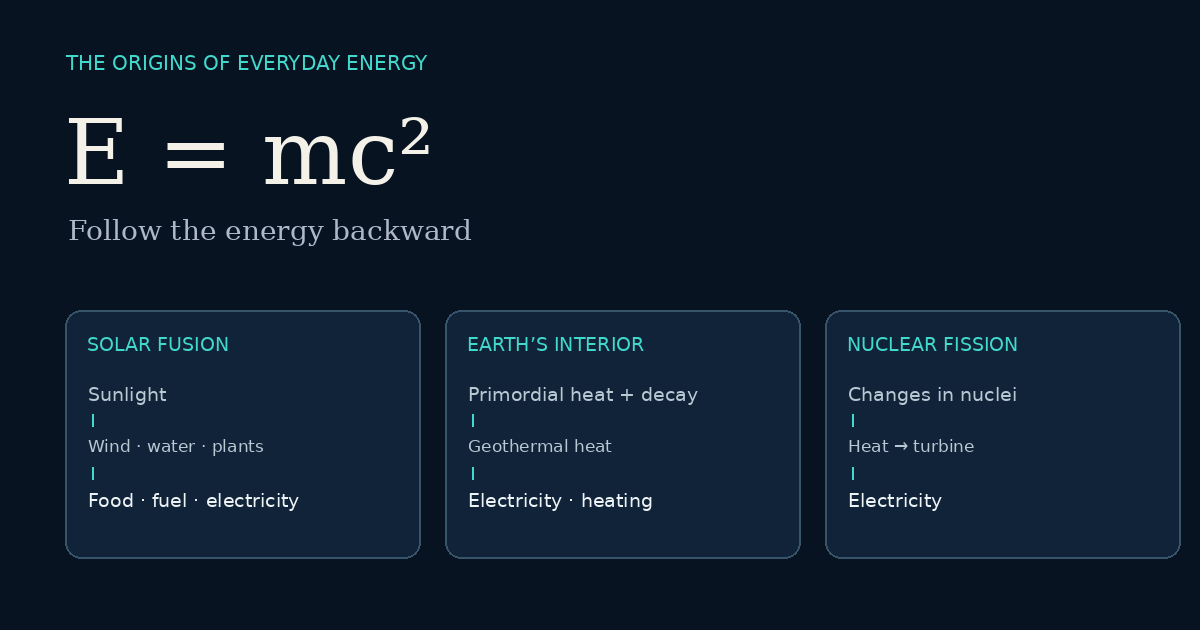
A bulb glows, a river flows, a car moves, a child runs and a satellite sends a signal. Each appears to use a different kind of energy. But if we keep asking where that energy came from, a remarkable pattern emerges: most of the energy that powers everyday life can be traced to nuclear processes, especially fusion in the Sun.
That was the idea behind my original article. Einstein’s compact equation, E = mc², does more than explain the enormous energy released in a reactor or a bomb. It also helps explain the distant origin of sunshine and, through it, many familiar energy chains. To see why, we must distinguish the form in which energy reaches us from the process that supplied it in the first place.
What do we mean by a source?
A bulb receives electricity. A toy draws on a battery. A car burns fuel. A person eats food. A hydroelectric turbine receives falling water. These are useful answers to “what powers it now?” They are not necessarily the end of the story. The battery had to acquire or store energy; the fuel and food had to form; water had to reach higher ground. In each case, we can step farther back.
Power stations illustrate the distinction. A generator converts motion into electricity. A gas or coal plant obtains that motion by burning fuel; a dam obtains it from falling water; a wind farm obtains it from moving air. Solar cells convert incoming light directly. A nuclear plant obtains heat from fission. “Electricity” names the delivered form, while each plant has its own upstream source.
Start at the Sun: nuclear fusion
Deep inside the Sun, hydrogen nuclei fuse into helium. The resulting system has slightly less mass than the starting particles, and the difference is released as energy. That is mass–energy equivalence in action: E = mc². Energy travels outward from the Sun and a small fraction eventually reaches Earth as light and heat.
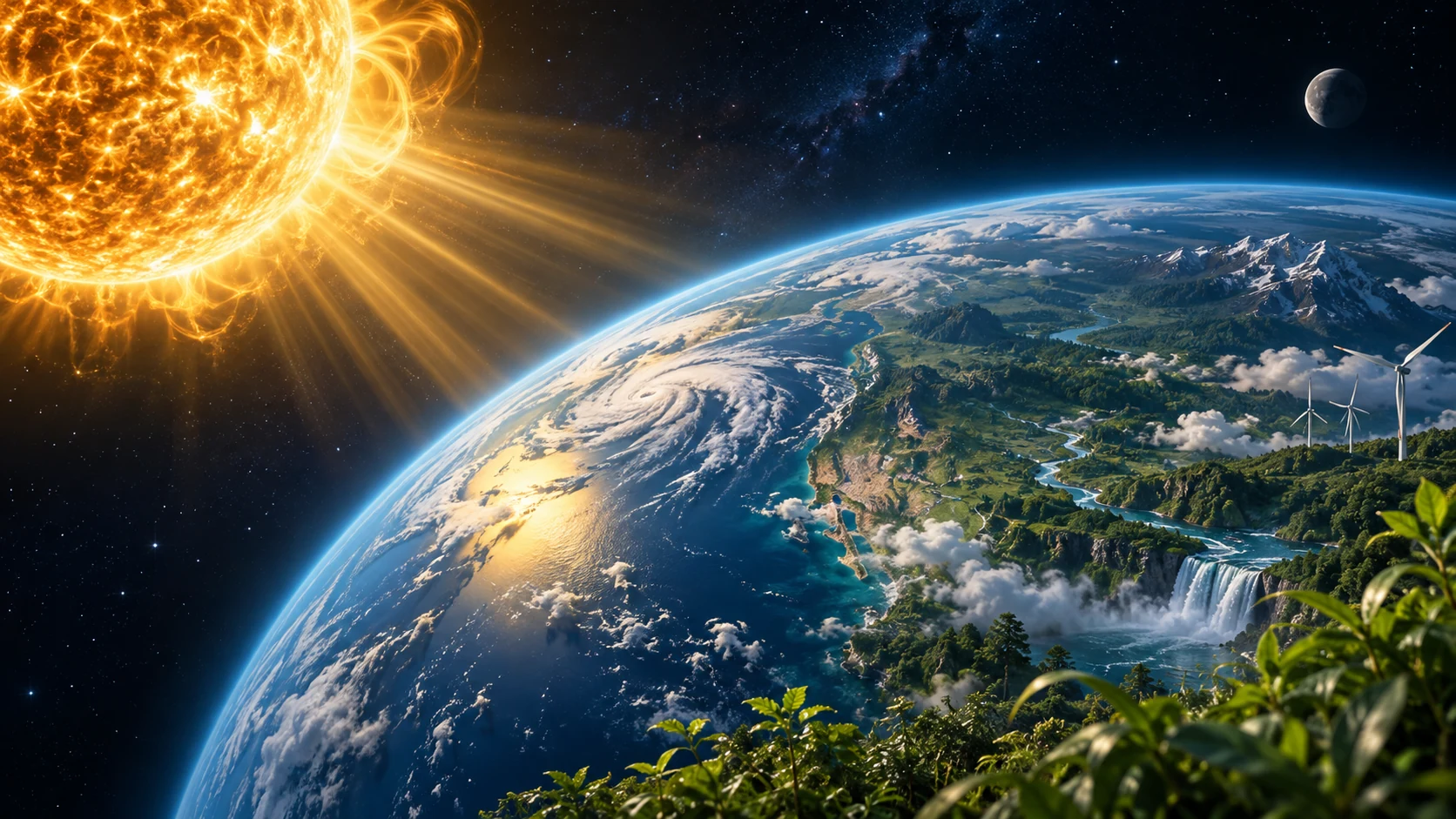
Daylight and solar power are the most direct examples. The Sun illuminates and warms Earth; photovoltaic cells convert part of its light into electricity. Solar thermal systems capture its heat. In both cases, the immediate source is sunlight and its deeper source is fusion.
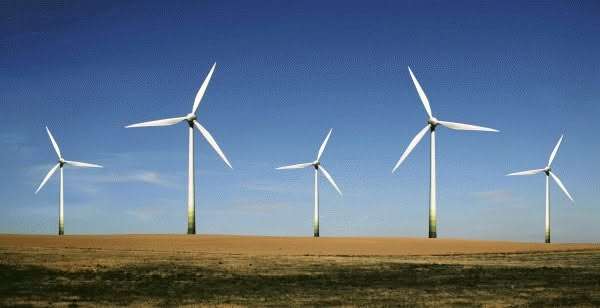
Wind comes largely from unequal heating of Earth’s surface, together with the planet’s rotation and atmospheric circulation. Differences in temperature and pressure help set air in motion. A wind turbine converts some of that motion into electricity. Follow the chain backward: wind → uneven solar heating → sunlight → fusion.
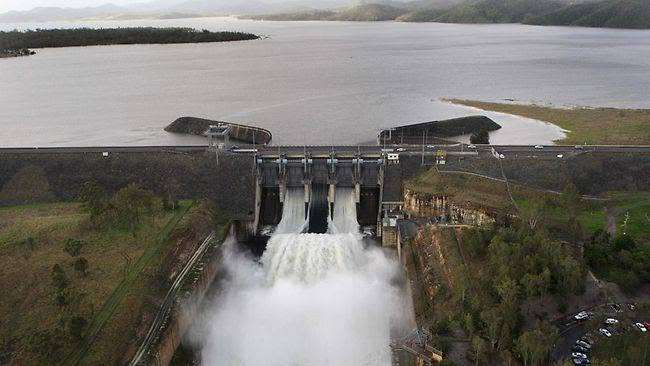
Rivers and hydroelectricity follow a longer path. Sunshine evaporates water. It returns as rain or snow, sometimes at high elevations, and gravity pulls it downhill. A dam can convert the water’s gravitational potential energy into the motion of a turbine and then electricity. The Sun drives the water cycle; gravity determines how stored energy is released.
Food carries the same story into our bodies. Plants use photosynthesis to make energy-rich molecules from carbon dioxide and water. Animals eat plants or other animals; we eat along that food chain. In our cells, mitochondria help convert the chemical energy in food into a usable form. Walking, working, playing and thinking are sustained by a chain that very often begins with sunlight. The body does not perform nuclear fusion: it releases stored chemical energy that plants captured earlier.
Fossil fuels preserve part of an ancient biological history. Coal, oil and gas formed from organic matter altered over geological time by burial, heat and pressure. The useful chemical energy in that matter originated predominantly with photosynthesis. Geological processes transformed and concentrated the material; Earth’s heat was not an additional major deposit of usable chemical energy into each fuel molecule. A petrol engine or a fuel-powered generator therefore releases energy that often traveled from solar fusion through ancient life before reaching us.
Earth’s interior: radioactive decay and older heat
Not every source takes a route through today’s sunshine. Earth’s interior supplies geothermal heat. Part of that heat is left over from the planet’s formation and differentiation. Another substantial part is continually generated by the radioactive decay of naturally occurring isotopes within Earth, especially in its crust and mantle. Geothermal systems bring some of this heat within reach for heating or electricity.
Decay is another nuclear process: an unstable nucleus changes and energy is carried away by particles and radiation, eventually contributing to heat. The original article emphasized this connection correctly, but placed the radioactive source too exclusively in Earth’s core and treated the planet’s older heat as if it came directly from an exploding star. Stellar explosions helped create and distribute many of the elements from which Earth formed; the heat retained from Earth’s formation is a different, gravitational and geological part of the story.
Nuclear power: a more direct route
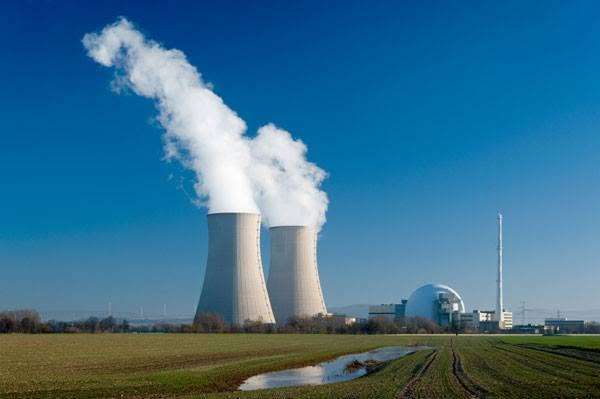
In a nuclear power plant, a controlled fission chain reaction splits heavy nuclei. The products have less total mass than the starting system, with the difference appearing as released energy according to E = mc². That energy becomes heat, produces steam, turns a turbine and generates electricity. Instead of waiting for sunlight to become wind, food or ancient fuel, the plant draws energy directly from changes in nuclei.
Small household generators do something different: they burn chemical fuel to turn an engine and an electrical generator. Batteries are different again. Rechargeable batteries store energy supplied through charging; disposable batteries draw on chemicals made and assembled through industrial processes. A battery is a carrier and store, not a fourth fundamental way of making energy. The upstream chain depends on how it was made or charged. Satellites using solar cells follow the Sun’s fusion chain; computers and bulbs follow whatever chain supplied their electricity.
Where the energy chains end—and where they do not
The original article gathered its examples under three nuclear mechanisms: fusion in stars, fission in reactors, and radioactive decay in nature. This is the central insight I want to keep. Much of our accessible energy comes either from the Sun’s fusion, from the decay heating Earth, or directly from a reactor’s fission. The familiar names—solar, wind, hydro, food, fossil fuels, geothermal, electricity—describe points along those chains.
The word all, however, is too strong. Tides draw on the gravitational interaction and motion of Earth, the Moon and the Sun, with tidal friction tapping Earth’s rotational energy. Some geothermal heat persists from Earth’s formation. Stored gravitational, rotational and orbital energy also matters. These do not fit neatly into the three nuclear pathways. The strong and defensible claim is that the dominant pathways behind many everyday energy sources are nuclear in origin, not that every joule we can ever use was produced by a nuclear reaction.
Nor does “nuclear” mean “radioactive” in precisely the same way in every case. Fusion in the Sun, fission in a reactor and spontaneous radioactive decay are different processes with different radiation environments. Energy is conserved in all of them: nuclear power does not create energy from nothing. It releases a very dense store of energy associated with changes in nuclei, while turbines, engines, cells and batteries convert or transfer energy that is already available.
Nuclear power? Yes, please
The original essay ended by questioning why we instinctively fear the word nuclear when so much ordinary life depends, indirectly, on nuclear processes. That question still matters. The sunlight that nurtures a plant and the heat released in a reactor arise through different nuclear processes and reach us under very different conditions. Their common origin does not make their risks identical, but it does challenge the idea that “nuclear” by itself means unnatural or necessarily harmful.
Radiation type, dose and exposure matter. Earth’s atmosphere and magnetic field shield us from much hazardous solar radiation; distance and the Sun’s own layers also shape what reaches Earth. A reactor must instead rely on engineered control, containment, cooling, regulation and waste management. Its safety should be judged on evidence and design, not by fear of a word—and not by the fact that sunlight also has a nuclear origin.
That is the spirit of the original conclusion: understand the physics, manage the hazards rigorously and keep exploring ways to use the immense energy available from nuclear processes. Fission is already a practical source of electricity; fusion remains a demanding engineering goal. The equation E = mc² invites curiosity about both. It connects the dramatic energy of a reactor to the quiet, long pathways behind a meal, a breeze and a glowing bulb.
Revised from my earlier Facebook article. This edition restores its central argument and examples while correcting several scientific overstatements. Background: DOE on fusion, DOE on geothermal heat, and NASA on tidal energy transfer.